Publish a Playwright HTML Report from GitHub Actions to a PR
Copy a GitHub Actions workflow that publishes your Playwright HTML report to DocHost and updates the same report URL and pull request comment on every push.
To share a Playwright HTML report from GitHub Actions, run Playwright with the HTML reporter, upload the complete report folder as a GitHub artifact, and publish its index.html to DocHost. The workflow below adds one comment to the pull request. Later commits replace the report at the same URL and edit that comment to point at the latest Actions run.
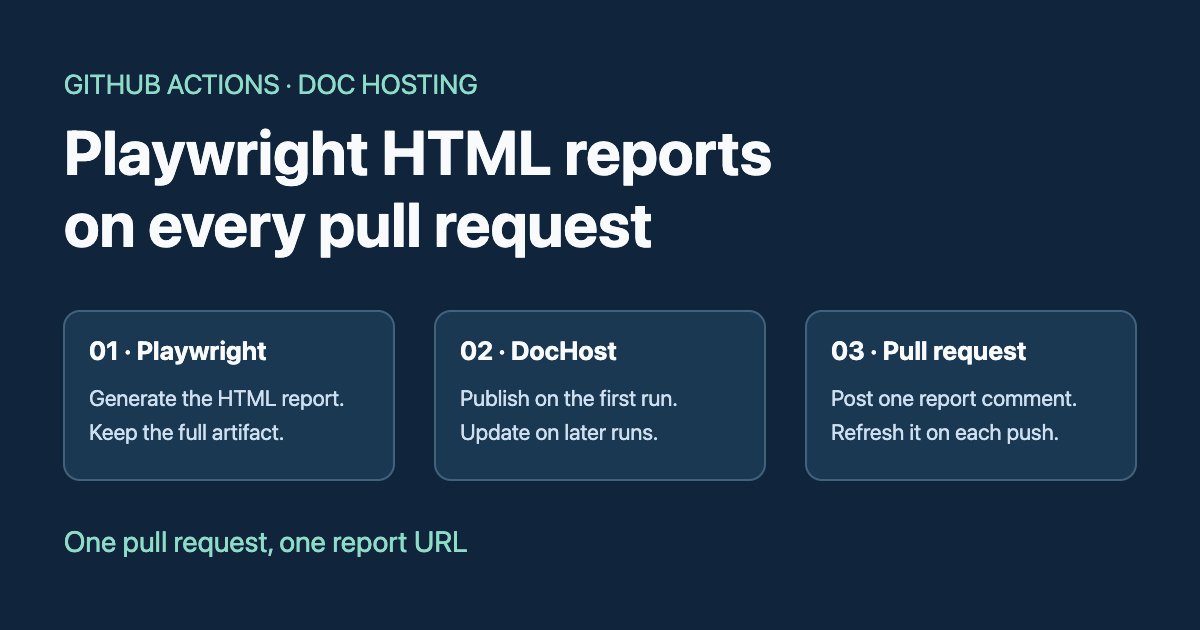
The diagram above shows where the two outputs go. The browser link gives reviewers a quick way to see test results. The complete artifact keeps the traces, screenshots, videos and other files that Playwright may store alongside index.html.
1. Set up the repository secret
Use a repository with Playwright Test installed, an npm lockfile, and a Playwright project named chromium. If your tests need a local app server, configure Playwright’s webServer in your project as usual. Playwright CI setup
Create a DocHost API key in Settings → API Keys. In GitHub, open your repository’s Settings → Secrets and variables → Actions, then save it as a repository secret named DOCHOST_API_KEY. The publish job reads it from the environment. DocHost API key walkthrough
2. Copy the GitHub Actions workflow
Save the workflow as .github/workflows/playwright-dochost.yml. If you use pnpm or a browser project with a different name, change the install and test commands to match. The workflow pins Ubuntu 24.04 for compatibility with Playwright 1.60. Download the YAML
name: Playwright report

on:
  pull_request:
    types: [opened, synchronize, reopened]

permissions:
  contents: read

concurrency:
  group: playwright-dochost-${{ github.event.pull_request.number }}
  cancel-in-progress: false

jobs:
  test:
    runs-on: ubuntu-24.04
    timeout-minutes: 20
    outputs:
      report-artifact: ${{ steps.report.outputs.artifact-id }}
    steps:
      - uses: actions/checkout@v6
        with:
          persist-credentials: false
      - uses: actions/setup-node@v6
        with:
          node-version: 24
          cache: npm
      - run: npm ci
      - run: npx playwright install --with-deps chromium
      - name: Run Playwright
        run: npx playwright test --project=chromium --reporter=html
        env:
          CI: 'true'
          PLAYWRIGHT_HTML_OPEN: never
          PLAYWRIGHT_HTML_OUTPUT_DIR: playwright-report
      - name: Save complete report and attachments
        id: report
        if: ${{ !cancelled() }}
        uses: actions/upload-artifact@v6
        with:
          name: playwright-report
          path: playwright-report/
          if-no-files-found: ignore

  share:
    needs: test
    if: >-
      ${{ !cancelled() && needs.test.outputs.report-artifact != ''
          && github.event.pull_request.head.repo.full_name == github.repository
          && github.actor != 'dependabot[bot]' }}
    runs-on: ubuntu-24.04
    timeout-minutes: 5
    permissions:
      pull-requests: write
    steps:
      - uses: actions/download-artifact@v7
        with:
          name: playwright-report
          path: playwright-report
      - name: Publish report and update PR comment
        uses: actions/github-script@v8
        env:
          DOCHOST_API_KEY: ${{ secrets.DOCHOST_API_KEY }}
          TEST_RESULT: ${{ needs.test.result }}
        with:
          script: |
            const fs = require('node:fs');
            const key = process.env.DOCHOST_API_KEY;
            if (!key) throw new Error('Set the DOCHOST_API_KEY repository secret.');

            const body = fs.readFileSync('playwright-report/index.html', 'utf8');
            const marker = '<!-- dochost-playwright-report -->';
            const { owner, repo } = context.repo;
            const issue_number = context.payload.pull_request.number;
            const runUrl = `${process.env.GITHUB_SERVER_URL}/${process.env.GITHUB_REPOSITORY}/actions/runs/${context.runId}`;

            async function call(name, args) {
              const response = await fetch('https://dochost.io/api/mcp', {
                method: 'POST',
                headers: {
                  Authorization: `Bearer ${key}`,
                  'Content-Type': 'application/json',
                  Accept: 'application/json',
                },
                body: JSON.stringify({
                  jsonrpc: '2.0', id: 1, method: 'tools/call',
                  params: { name, arguments: args },
                }),
                signal: AbortSignal.timeout(30_000),
              });
              if (!response.ok) throw new Error(`DocHost ${name}: HTTP ${response.status}`);
              const { result, error } = await response.json();
              if (error || result?.isError || !result?.structuredContent) {
                throw new Error(`DocHost ${name} failed. Check API key, page access and file size.`);
              }
              return result.structuredContent;
            }

            const { data: pr } = await github.rest.pulls.get({ owner, repo, pull_number: issue_number });
            if (pr.head.sha !== context.payload.pull_request.head.sha) {
              core.notice('Skipping a superseded commit.');
              return;
            }

            const comments = await github.paginate(github.rest.issues.listComments, {
              owner, repo, issue_number, per_page: 100,
            });
            const previous = comments.find(({ user, body }) =>
              user?.login === 'github-actions[bot]' && body?.startsWith(marker + '\n'));
            const slug = previous?.body.match(/^<!-- dochost-slug: ([a-z0-9-]{1,64}) -->$/m)?.[1];
            const savedUrl = previous?.body.match(/^\[Open the report\]\((https:\/\/[^)]+)\)/m)?.[1];
            if (previous && (!slug || !savedUrl)) {
              throw new Error('Existing report comment is missing its DocHost slug or URL.');
            }

            // CI owns this page and replaces the entire report on each run.
            // Keep the original URL from the bot comment, even if the primary domain changes.
            const report = slug
              ? { slug, url: savedUrl }
              : await call('publish', { body, format: 'html', public: false });
            const url = new URL(report.url);
            if (url.protocol !== 'https:' || !/^[a-z0-9-]{1,64}$/.test(report.slug)) {
              throw new Error('DocHost returned an unexpected URL or slug.');
            }
            if (slug) await call('update_page', { slug, body, format: 'html' });

            const comment = [
              marker,
              `<!-- dochost-slug: ${report.slug} -->`,
              '### Playwright HTML report',
              `[Open the report](${url.href}) · [Actions run and full artifact](${runUrl})`,
              `Test job: **${process.env.TEST_RESULT}** · Commit: \`${pr.head.sha.slice(0, 7)}\``,
            ].join('\n');

            if (previous) {
              await github.rest.issues.updateComment({ owner, repo, comment_id: previous.id, body: comment });
            } else {
              await github.rest.issues.createComment({ owner, repo, issue_number, body: comment });
            }
The test job keeps its original pass or fail result. If Playwright produces a report on a failed test run, the artifact upload and the separate share job still run. For fork PRs, the workflow runs tests and uploads the artifact, while the share job skips the DocHost write and PR comment. The share job downloads the artifact without checking out or running PR code. Its GitHub token can write PR comments. GitHub Actions workflow syntax
3. Check the report link on the pull request
Open a pull request from a branch in the same repository. When the workflow finishes, look for the Playwright HTML report comment and open its report link. Push a change that alters a test result or test title. Open the same report URL after the next run and check that the changed result appears. The original comment should now show the newer commit and Actions run.

The first run calls publish with public: false and stores the returned slug in a hidden marker in the bot’s comment. Later runs read the slug and original URL from that comment and call update_page. The workflow replaces the entire page with the new generated report, so reserve the page for CI. This avoids downloading the previous HTML through the MCP content reader, which has a 256 KB response limit. Runs are serialized per PR and a run checks the current head before writing. If a comment is deleted, a later run has no slug to recover and creates a fresh report.
What reviewers can open
Share only reports whose contents are suitable for everyone who might receive the link. public: false keeps the report off Explore. Anyone with the URL can read it without an account. Use the GitHub artifact for reports with sensitive test data, internal URLs, screenshots or credentials.
The hosted page contains one HTML file. The tests and results embedded in that file can be browsed there. For linked attachments or Trace Viewer assets, use the artifact from the Actions run, extract it, and run npx playwright show-report <extracted-folder>. Playwright HTML reports
FAQ
Can I publish the report when a test fails?
Yes, if Playwright finished writing index.html. The upload step still runs after test failures and the failed job stays visible in GitHub. If a setup error prevents the report from being created, check the test job logs.
Does each push get a new DocHost link?
The first successful publication creates the URL. Later runs reuse the slug saved in the bot comment and update the page. The comment changes to show the latest run and commit.
How long does the link stay available?
A free link published off Explore lasts three days. An update preserves the existing expiration date. Use a permanent plan if reviewers need the link beyond the free window. If you need the history of individual runs, keep the artifacts in GitHub.
Can a fork pull request publish a report?
This workflow skips the publish job for forks and Dependabot. Reviewers can still use the GitHub artifact when the tests are allowed to run.
To try publishing a standalone HTML report in the browser, open the client report demo.
Autor

Categorias
Mais posts
What Happens When a dochost Page Expires, and How to Bring It Back
After 7 days a free page shows an expired notice instead of the content. Nothing is deleted: the page, its URL, its views and likes are all kept. Here is what readers see, what the owner sees, and the three ways to put the same link back online.
How to Share a Mermaid Diagram as a Link
The fastest way to turn Mermaid code into a rendered diagram anyone can open in a browser — no screenshots, no repo, and no account required.
Claude Skills vs Projects vs Artifacts: What Each One Actually Is
Three Claude features with overlapping names and completely different jobs. Skills are procedures, Projects are context, Artifacts are output — here's how to tell which one you need.
Newsletter
Faça parte da comunidade
Inscreva-se na nossa newsletter e fique por dentro das novidades