Tiiny.host vs Netlify Drop: The Fastest Way to Put One HTML File Online
A head-to-head look at Tiiny.host and Netlify Drop for getting a single HTML file online — setup, accounts, free-tier limits, and where dochost fits.
You have one HTML file. Maybe a tool exported it, maybe ChatGPT or Claude generated it, maybe you hand-wrote a landing page mockup. It works when you double-click it — and it's completely invisible to everyone else. You need a URL, and you'd rather not learn a deployment pipeline to get one.
Tiiny.host and Netlify Drop are the two names that come up most for this. Both are drag-and-drop hosts, but they're built for different people, and the differences show up exactly where it hurts: how much setup stands between you and a link, and what happens to that link a week later.
Tiiny.host: drag, drop, sign up, publish
Tiiny.host is aimed squarely at non-deployment people: designers sharing a prototype, students posting a project, anyone with a file and no interest in hosting.
The flow is genuinely simple. You can drop a single .html file directly — no zip needed for one page. If your page has separate CSS or JS files, you zip the folder (with an index.html inside) and upload that instead. Pick a name for your link, hit publish, done.
The catch is the account. Tiiny's homepage pitches a try-before-signup experience, but its own how-to guides list "Login or Sign up" as the first step before you reach the upload dashboard — and the link's lifespan is tied to that account. Per their help center, free links stay online indefinitely as long as you log into your account once a month. Forget about it for a while and the link can go with it.
The free tier is real but tight: one project, a 3 MB upload cap, a monthly visitor limit, and a Tiiny Host banner on your page. Removing the banner, adding a password, connecting a custom domain, or hosting more (and bigger) projects all require a paid plan. For a single lightweight HTML file shown to a handful of people, the free tier covers it; for anything else you'll hit a wall quickly.
Netlify Drop: a folder in, a real static site out
Netlify Drop is the drag-and-drop front door to Netlify, a full static-hosting platform. You go to the Drop page, drag in your project folder or a zip of it, and get a live site at a netlify.app URL.
Note the unit: a folder, not a file. Drop is built around the idea of a site, so the natural move is to put your file in a folder (named index.html, so it serves at the root) and drag the folder in. It's a small step, but it's the first hint that you're using a site deployment tool for a one-file job.
The account story is the bigger one. You can drop a site without signing in, but that deploy is explicitly temporary — Netlify's docs describe a one-hour window to claim an anonymous deploy with an account before it's gone. In practice, if you want a link that survives the afternoon, you're creating a Netlify account. Once claimed, though, the deal is good: the free tier is generous for personal projects, the site doesn't expire, and there's no banner injected into your page. Updating means dragging the updated folder onto the site's deploys page.
And if the project grows, Netlify grows with it: connect a Git repo and you get automatic builds, deploy previews, rollbacks — an actual professional pipeline. That's the real reason to choose Drop: not the drag-and-drop itself, but what's behind it.
Head-to-head for the one-file job
For the specific task of "put this one HTML file online now":
- Setup friction. Tiiny wins on upload format (a bare
.htmlfile is fine); Netlify wants a folder or zip. Both effectively route you through account creation before you have a durable link. - Link over time. Netlify is the stronger promise: a claimed free site just stays up. Tiiny's free link persists too, but only while you keep logging in monthly — a strange chore for a file you shared once.
- The page itself. Netlify serves your file untouched. Tiiny's free tier puts its banner on your page, which matters if the person opening the link is a client.
- Ceiling. Tiiny free tops out at one small project. Netlify's free tier can carry you from one file to a real multi-page site without switching tools.
If you'll ever have more than one file — a site, a project with builds, anything ongoing — Netlify Drop is the better on-ramp, full stop. If you're allergic to anything that smells like a developer tool and your file is small, Tiiny's flow will feel friendlier.
But notice what both have in common: an account, a dashboard, and a mental model built around sites. Your actual situation is a single file and a person waiting to see it.
Where dochost fits: skip the file manager entirely
dochost attacks the same job from the other side. Instead of treating your HTML as a site to be deployed, it treats it as content to be shared. You paste the markup (or upload the file — either works), see a live preview, click publish, and get a short link. No zip, no folder, no account, no claim window. If the HTML came out of ChatGPT or Claude, there's a Chrome extension that adds a one-click publish button right in the chat, and the HTML to URL page does the same thing for anything on your clipboard.
The page renders exactly as authored — inline CSS and JavaScript run as written, and CDN-loaded fonts or frameworks work — so interactive one-pagers, little dashboards, and quizzes behave like they did locally. It handles Markdown too, rendered to a clean themed page, if what you're sharing is a doc rather than a page.
The honest trade-off is lifespan. Free links last 7 days, with or without an account; permanent links (plus custom slugs and password protection) are on the paid plans. For "review this by Friday," 7 days is exactly right. For "this is my portfolio," it isn't — that's Netlify territory.
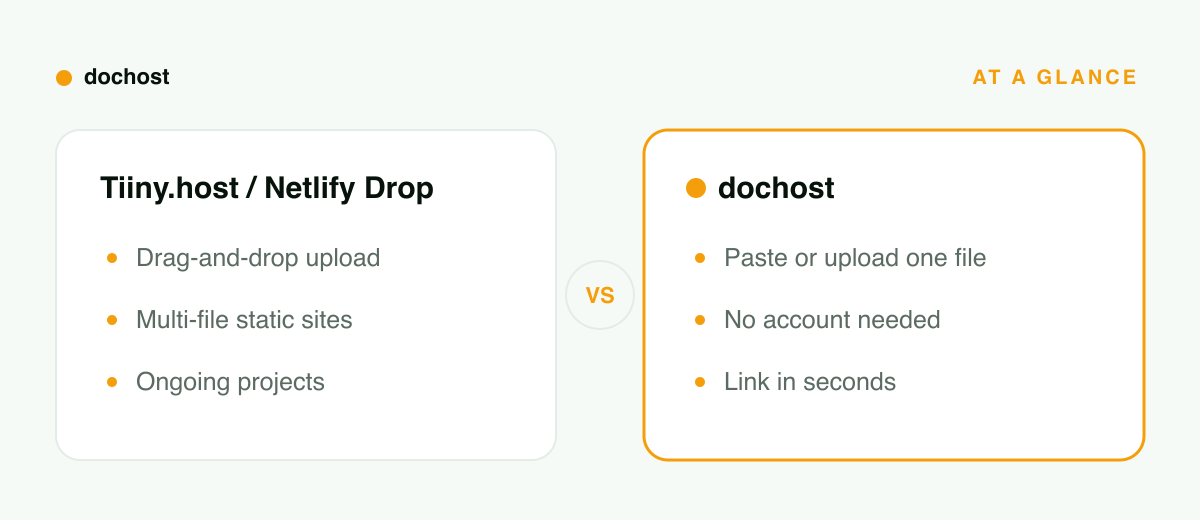
At a glance
| Tiiny.host | Netlify Drop | dochost | |
|---|---|---|---|
| Setup | Drag file, name link, publish | Drag folder/zip to Drop zone | Paste markup or upload, publish |
| Account | Yes, in the publish flow | Yes, to keep the site (anonymous deploys are temporary) | No — optional |
| Upload format | Single .html or zip | Folder or zip | Pasted HTML/Markdown or a file |
| Free limits | 1 project, 3 MB, banner on page | Generous; no banner | No zip/size ceremony; 7-day link |
| Link over time | Stays up if you log in monthly | Stays up once claimed | 7d free / permanent paid |
| Best for | Non-devs sharing one small page | Real sites and ongoing projects | Fast, disposable sharing of one file |
Which one should you actually use?
- Use Netlify Drop when the file is the seed of something ongoing — a site you'll update, a project that will eventually want a custom domain and a build step. The folder-and-account ceremony pays for itself the second time you deploy.
- Use Tiiny.host when you want a persistent single page, you're fine with an account and the free tier's banner and size cap — or you'll pay to lift them.
- Use dochost when the file is the deliverable: an AI-generated page, a prototype, a report someone needs to open today. Paste, publish, send the link, move on. (If it's Markdown from a chat instead of HTML, the same flow applies.)
Bottom line: Netlify Drop is a deployment platform with a friendly front door; Tiiny.host is a file host with an account attached. If you have a site, use Netlify. If you have exactly one HTML file and a person waiting on it, paste it into dochost and have the link before either signup form loads.
更多文章
Rentry vs dochost: Two Ways to Share Markdown as a Link
An honest look at when Rentry's anonymous, permanent Markdown pages beat dochost — and when rendered HTML, Mermaid diagrams, and LaTeX math change the call.

How to Unpublish a Claude Artifact — and Why You Only Get One Shot
Open the artifact, click Share or Published at its top right, then Unpublish. It's permanent: that artifact can't be republished and its stored data is deleted.
Why Your JavaScript Works Locally but Not on the Published Page (and What Does Work)
Published dochost pages run their own scripts — storage, dialogs, downloads, clipboard, fetch all work. When a page looks fine but a button does nothing, it is almost always one of six things. A checklist, with a live test page you can compare against.
邮件列表
加入我们的社区
订阅邮件列表,及时获取最新消息和更新